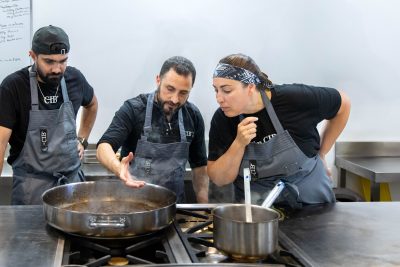
Sweet cuisine: why the pastry chef is also a cook
The idea that a pastry chef is, at heart, a cook who works with sweet ingredients is attributed to Ferran Adrià, and it sums up the philosophy of the Culinary Institute of Barcelona (CIB) well: the action is the same, cooking, and only the pantry changes. When someone asks “what is sweet cuisine?”, the answer is simple: applying the techniques, ingredients and reasoning of the kitchen to pastry, with no borders between savory and sweet.
A revolution that reached the pastry workshop late
The technical and conceptual revolution in cooking, with its gelling agents, foams and frozen textures, took hold first in savory cuisine. In pastry it arrived later and almost always through the restaurant door, where dessert is conceived as just another dish on the menu. The traditional workshop, designed around the display case and shelf life, still views these techniques with suspicion. Today the trend toward savory and sweet pastry is building bridges: vegetables, herbs, oils and fermented ingredients are already part of signature pastry.
Linear cuisine and the three-ingredient rule
The classic menu climbs to a peak of intensity (the meat) and falls away at dessert, when diners no longer have an appetite. Linear cuisine proposes sustaining interest from beginning to end, even swapping dishes between starters and desserts. Its design principle is simplicity:
- One star ingredient.
- A maximum of three ingredients per dish.
- A flavor the diner can identify effortlessly.
This reasoning is explored across the board in the Advanced Pastry Course, where each cook’s gastronomic memory (the family stew, the everyday soup) becomes creative raw material for end-of-menu dishes.
Local and seasonal produce in signature pastry
Working only with local, seasonal produce narrows the repertoire, and that limitation is precisely what forces creativity. When you give up imported vanilla, chocolate or citrus, the pastry chef must ask what the surrounding region offers to fulfil the same role on the plate. The answer is usually more personal and recognizable than any catalog recipe.
Smart substitutions
- Roasted, ground carob instead of cocoa: depending on the roast, it recalls cocoa, licorice or coffee, and it is more economical.
- Buckwheat instead of rice in milk-based desserts.
- Tiger nut, truffle or sheep’s milk as the main aromas instead of vanilla.
- Apricot with vermouth or mountain herbs instead of the usual citrus profiles.
Indicative seasonal calendar for Catalonia and the Iberian Peninsula
- Winter: pumpkin, artichoke, cabbage, black truffle, orange and mandarin.
- Spring: pea, asparagus, rhubarb, strawberry and fresh herbs.
- Summer: eggplant, pepper, tomato, cherry, apricot and tiger nut.
- Autumn: mushrooms, quince, chestnut, pomegranate and pumpkin.
Beyond the rhetoric, local produce offers more flavor, greater freshness and a lower carbon footprint from transport and storage. Regional and high-mountain cuisine, which a few years ago was a risky bet, is now an established trend that seasonal pastry is beginning to explore in its own language.

Vegetables and mushrooms in dessert: cooking, sugars and flavor balance
Vegetables in baking work when you decide the desired result (flavor, texture) first and the cooking method second. Boiling is not the same as roasting: boiling dilutes sugars and aromas, while roasting concentrates them. Pumpkin, eggplant, pepper and avocado have a modest natural sugar content, but a good roast multiplies it in perception.
Maillard and caramelization
Above roughly 140–165 °C (285–330 °F), the amino acids and reducing sugars in vegetables react (the Maillard reaction), generating toasty, nutty notes. At the same time, simple sugars caramelize (fructose from about 110 °C, sucrose around 160 °C). That is why a well-roasted pumpkin tastes like dessert with barely any help.
Balancing bitterness, acidity and earthy notes
A neutral vegetable such as eggplant can take powerful glazes; a more bitter one calls for fat, salt or a touch of acidity. Avocado, for example, needs citrus acidity, which also slows its enzymatic oxidation. In mushroom desserts, umami compounds (glutamate and guanylate) and earthy notes pair well with fruits such as quince, with creamy dairy and with chocolate. This is the logic of foodpairing: ingredients that share aromatic compounds work well together on the plate. These principles are expanded in the Specialist Program in Advanced Culinary Techniques.
Texturizers and gelling agents in pastry: when and how much to use
The professional standard is judicious use: a texturizer should provide structure without masking the produce. Overusing gelatin to extend shelf life produces rubbery desserts with muted flavor. A chocolate mousse, for example, can be held together by cocoa butter and a meringue alone, preserving its full flavor.
Technical comparison of common hydrocolloids
| Ingredient | Indicative dosage | Thermal behavior | Texture |
|---|---|---|---|
| Gelatin | 1–3% | Dissolves at ~50 °C; melts at 30–35 °C | Elastic, melts in the mouth |
| Agar-agar | 0.3–1.5% | Must boil to hydrate; sets at 35–45 °C; withstands up to ~80 °C | Firm and brittle |
| Iota carrageenan | 0.5–1.5% | Thermoreversible; melts at 55–70 °C | Soft and elastic |
| Pectin | 0.5–2% | Depends on type; HM pectin needs sugar and acidic pH | Unctuous, jam-like |
| Xanthan gum | 0.1–0.5% | Stable hot and cold | Thickens and adds sheen, without gelling |
Gels, foams, emulsions and regulations
A gel traps liquid in a network; a foam incorporates air; an emulsion disperses fat and water. Acids, alcohol and high sugar levels alter gelation, so every combination should always be tested. A useful trick is to blend a light gel to obtain a creamy texture that behaves like a sauce.
If sold to the public, gelling agents are additives with E numbers (agar E406, pectin E440, xanthan E415) regulated by Regulation (EC) No 1333/2008, and labeling must comply with Regulation (EU) No 1169/2011, including allergens. Thinking in terms of contrast (creamy, crunchy, unctuous, fresh) also keeps the dessert from being just a purée.
Managing a product-led pastry shop: freshness, waste and signature keepsakes
A signature workshop depends on management as much as on technique. Consistency begins with freshness: freezing can be a production tool (unmolding, organization), but what reaches the customer should ideally be fresh and for immediate consumption. That decision shapes all planning.
Pre-orders, waste and costing
Demand in a pastry shop is irregular: weekends multiply volume and weekdays drop, with no exact figure. Educating customers to pre-order is the most effective tool for adjusting production and reducing waste. Other good practices:
- Cost every preparation, including trimming and cooking loss for vegetables and mushrooms.
- Reuse trimmings and peels in creams, crumbles, powders or infusions.
- Specialize in a few well-executed items rather than an unmanageable display case.
- Offer formats such as mini desserts for events, which extend shelf life.
Food safety and the emblematic product
Dairy and cooked vegetables require a HACCP system and a controlled cold chain (below 4 °C in storage, with rapid chilling after cooking). At the same time, a keepsake product, such as a bonbon or a figure tied to the region, with low water content and a long shelf life, turns a visit into a brand. To master this complete vision, the Pastry Chef Diploma and the Professional Pastry and Baking Course combine technique, production and business.
Frequently asked questions
Which vegetables are used in baking and pastry?
The most common are pumpkin, carrot, beetroot, sweet potato, eggplant, pepper, avocado, zucchini and artichoke. Sweet or neutral vegetables work best, roasted to concentrate sugars and always balanced with acidity, salt or fat.
Can you make desserts with mushrooms?
Yes. Some aromatic mushrooms, such as black trumpet, release sweet notes when cooked. They are confited with sugar and pair well with quince, dairy, nuts or chocolate.
Which vegetables go with chocolate?
Roasted pepper, beetroot, avocado, pumpkin and glazed eggplant are good partners. A touch of salt, olive oil or mild heat enhances the chocolate without competing with it.
How do you stop a vegetable dessert from tasting salty or bitter?
Choose the right cooking method (roasting concentrates sweetness), use salt as a flavor enhancer and offset bitterness with fat, sugar or acidity. Taste the complete dish, because each component is perceived differently as a whole.
How do you design a balanced dessert that stays true to the produce?
Start from one star ingredient and use three ingredients at most. Build contrasts of texture (creamy, crunchy, frozen), flavor (acidic, bitter, spicy) and temperature, and avoid making everything a purée. You can explore this method further in the Advanced Pastry Course.
Is frozen produce acceptable in pastry?
Yes, as a workshop tool, for example to produce and unmold with precision. It is less advisable for the final product on sale, because freshness is what justifies a product-led pastry shop.
Frequently asked questions
-
Which vegetables are used in baking and pastry?
The most common are pumpkin, carrot, beetroot, sweet potato, eggplant, pepper, avocado, zucchini and artichoke. Sweet or neutral vegetables work best, roasted to concentrate sugars and always balanced with acidity, salt or fat. -
Can you make desserts with mushrooms?
Yes. Some aromatic mushrooms, such as black trumpet, release sweet notes when cooked. They are confited with sugar and pair well with quince, dairy, nuts or chocolate. -
Which vegetables go with chocolate?
Roasted pepper, beetroot, avocado, pumpkin and glazed eggplant are good partners. A touch of salt, olive oil or mild heat enhances the chocolate without competing with it. -
How do you stop a vegetable dessert from tasting salty or bitter?
Choose the right cooking method (roasting concentrates sweetness), use salt as a flavor enhancer and offset bitterness with fat, sugar or acidity. Taste the complete dish, because each component is perceived differently as a whole. -
How do you design a balanced dessert that stays true to the produce?
Start from one star ingredient and use three ingredients at most. Build contrasts of texture (creamy, crunchy, frozen), flavor (acidic, bitter, spicy) and temperature, and avoid making everything a purée. -
Is frozen produce acceptable in pastry?
Yes, as a workshop tool, for example to produce and unmold with precision. It is less advisable for the final product on sale, because freshness is what justifies a product-led pastry shop.