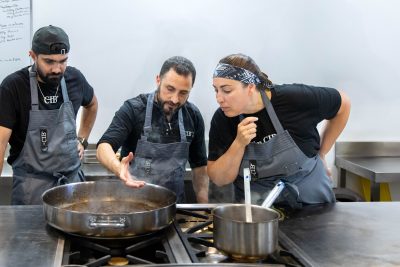
Why story is the backbone of the dining experience
A menu can be flawless and still go unnoticed. The dish and the technique are essential, but what gives the experience meaning is the narrative that surrounds them: why the concept exists, where it comes from and what it aims to make guests feel. That is why the Haute Cuisine Chef Diploma is built on the idea that a cook designs complete experiences, not just preparations.
Marketing is more than communication
Reducing it to persuasion is a mistake. The marketing mix is made up of the four Ps:
- Product: the dish, the menu or the service, designed after studying the market and the competition.
- Price: what the customer is willing to pay for that value.
- Place: how it is accessed: dining room, online booking, takeaway.
- Promotion: communication, which comes at the end of the process.
The diner funnel
Nobody books after watching a single video: guests move through a four-stage funnel.
| Stage | What happens | Where it is measured |
|---|---|---|
| Awareness | The diner discovers the restaurant | Reach, views |
| Consideration | Compares the website, Instagram and Google Maps | Profile visits, clicks |
| Decision | Books or buys | Bookings, conversion |
| Loyalty | Returns and recommends | Repeat purchases, reviews |
Today, many diners choose where to eat after watching social content, browsing photos on Google Maps and reading reviews. That is why WhatsApp, YouTube and maps are considered social media: they connect business and customer in both directions, even if the boundary is blurry. A streaming platform is not, unless it generates conversation around it.
The hero’s journey as a narrative structure for a menu or restaurant
Storytelling turns facts into a narrative with three parts: a beginning (the why), a middle (the process or the tension that holds attention) and an end (the result). Those who only communicate prices, ingredients and promotions sound like everyone else, and selling should be the last resort of marketing.
From Campbell’s monomyth to marketing
In 1949, Joseph Campbell described the monomyth: a protagonist leaves their ordinary world, faces trials with the help of a mentor and returns transformed. Christopher Vogler adapted it for film and, later, for brand marketing. Applied to the kitchen, the hero can be the cook, the product or even the diner.
- Ordinary world: the starting point of the cuisine or the territory.
- Call and mentors: what drives the urge to create and who shows the way.
- Trials: the technical, sourcing and craft difficulties.
- Return transformed: the menu as the result of that entire journey.
Why it works
Research on narrative transportation shows that a well-told story lowers audience resistance and strengthens memory and emotional connection. Cases such as the Nordic cuisine of Noma or the laboratory spirit of elBulli demonstrate the power of a narrative that is coherent from start to finish.
A good synthesis exercise is to summarize it in three lines: why the concept exists, what makes it difficult and what you want the diner to feel. Resorting to ready-made classic myths is the easy route; the most credible story comes from your own career path. And it is never wise to force a dish into a narrative that does not belong to it: audiences notice when something doesn’t fit.
The two-second hook and video as the king of formats
Capturing attention is easy; holding it is what matters. Studies put the window for stopping the scroll at around two seconds, and some recent figures put it even lower. That is why current videos start with the outcome or the moment of greatest impact, and then tell the story.
The most common types of hook
| Type | Kitchen example |
|---|---|
| Question | “Why does this sauce never split?” |
| Surprising fact | An unexpected number or temperature |
| Unexpected image | A cut, a flame or a pour in close-up |
| Promise of a result | “This is how you get a perfect texture” |
Show, don’t tell
Don’t say “crunchy”: let viewers hear the crunch and show the reaction of whoever tastes it. Cooking offers texture, heat, precision and craft, and all of it is visual. Mastering technique, as developed in the Specialist Program in Advanced Culinary Techniques, provides gestures worth showing.
Algorithm, duration and sound
Reels, TikTok and YouTube Shorts recommend content based on retention: percentage watched, replays and saves. A video can last ten seconds or several minutes, but the first two must hook. Add subtitles, because many users watch without sound, and design the audio (a bottle, a pan) as part of the hook. The real cost of video is time: scripting, filming in a clean kitchen, editing and rehearsal.
Defining your audience before posting: from segmentation to Meta advertising
The “audience first” principle reverses the usual order: before deciding what to post, you define who you are speaking to. A restaurant can open with what its team likes or analyze the neighborhood, tourism and consumer habits. Neither option is universally right, but deciding without data is betting blind.
Buyer persona and segmentation
The buyer persona is a portrait of the ideal customer: age, area, interests, moment of consumption. Meta Ads lets you translate it into targeting:
- Geographic: from a wide radius down to a postal code. The smaller the audience, the cheaper it tends to be to reach.
- Demographic: age and gender.
- Interests: events, music, gastronomy, nightlife.
- Lookalike audiences: people similar to your current customers.
Campaign structure and metrics
Every campaign is organized on three levels: objective (bookings, messages, traffic), ad set (audience, budget, placement) and ad (creative). The key metrics are reach, CTR, cost per result and conversion. Note that high reach does not equal engagement; also measure comments, saves and messages.
Test campaign
A sensible approach is to set aside 10% to 20% of the budget to test audiences with A/B tests: keep the one that performs, discard the others and optimize continuously. In local hospitality, modest budgets are enough. This business perspective is also explored in depth in the Executive Chef & F&B Management Postgraduate.
Content onion, platform choice and consistency
At the start you have too many ideas; after a year, new ones are hard to find. The content onion solves this: at the center is the core (the chef, the restaurant, a product or a specific cuisine; only one) and around it, three rings of ideas that grow more distant but always keep a path back to the center.
Repurposing and editorial calendar
A pillar piece, such as a long video on the origin of a dish, is broken down into smaller pieces: a reel with the key moment, a photo for the Google profile, a carousel showing the process. An editorial calendar prevents improvisation and keeps a single thematic line.
One platform, one job
| Platform | Main use |
|---|---|
| Visual discovery and local community | |
| TikTok | Organic reach with short-form video |
| YouTube | Keyword search and lasting content |
| Personal brand and professional relationships | |
| Google Business Profile | Local visibility, photos and reviews |
Choose according to your audience, the funnel stage and your comfort with video; don’t post the same thing everywhere.
Consistency over virality
One quality piece a week is usually enough. Regularity builds brand trust and improves the signal the algorithm receives, which rewards retention and saves. Replying to messages quickly matters more than posting stories every day. These strategic decisions are part of the comprehensive vision of the Gran Chef Diploma.
Frequently asked questions
What is a hook and how do you create one?
It is the grab in the first two seconds that stops users from continuing to scroll. You create it by planning it before filming: start with the moment of greatest impact (an image, sound, question or fact) and tell the story afterwards.
What is storytelling in a restaurant?
It is communicating the why behind the concept through a narrative with a beginning, middle and end. It connects emotionally with the diner and sets the restaurant apart beyond price or ingredients.
Which social network is best for a chef?
It depends on your audience and the format you master. Instagram is the most common choice for local discovery; TikTok and YouTube extend reach through video; Google Business Profile is essential for anyone searching for where to eat.
How much should you invest in Meta advertising?
There is no single figure. A local business can start with a few tens of euros a month, allocating 10-20% of the budget to testing audiences and measuring cost per result before scaling.
How do you work with influencers ethically?
Choose creators whose audience is real and relevant, and demand transparency. In Spain, Autocontrol’s Code of Conduct on influencers and the audiovisual regulations overseen by the CNMC require sponsored content to be clearly identified (for example, with “advertising” or “ad”). Local micro-creators tend to bring more authenticity than mass-market profiles.
How do you tell stories without misrepresenting the identity of your cuisine?
Only tell what you can deliver at the table. If a video promises something the dish doesn’t offer, diners will notice and reflect it in their reviews. Your strategy must be consistent with your professional integrity.
Frequently asked questions
-
What is a hook and how do you create one?
It is the grab in the first two seconds that stops users from continuing to scroll. You create it by planning it before filming: start with the moment of greatest impact (an image, sound, question or fact) and tell the story afterwards. -
What is storytelling in a restaurant?
It is communicating the why behind the concept through a narrative with a beginning, middle and end. It connects emotionally with the diner and sets the restaurant apart beyond price or ingredients. -
Which social network is best for a chef?
It depends on your audience and the format you master. Instagram is the most common choice for local discovery; TikTok and YouTube extend reach through video; Google Business Profile is essential for anyone searching for where to eat. -
How much should you invest in Meta advertising?
There is no single figure. A local business can start with a few tens of euros a month, allocating 10-20% of the budget to testing audiences and measuring cost per result before scaling. -
How do you work with influencers ethically?
Choose creators with a real, relevant audience and demand transparency. In Spain, Autocontrol’s Code of Conduct on influencers and the audiovisual regulations overseen by the CNMC require sponsored content to be clearly identified. Local micro-creators usually bring more authenticity. -
How do you tell stories without misrepresenting the identity of your cuisine?
Only tell what you can deliver at the table. If a video promises something the dish doesn’t offer, diners will notice and reflect it in their reviews. Your strategy must be consistent with your professional integrity.