Gastronomy demands more than passion: it demands judgment. If you’re here, it’s probably because you’re facing one of the most important decisions of your professional life:
Do I start working in a restaurant right away to gain real experience? Or do I invest in an education that gives me the tools to build something bigger?
It’s a classic debate, and like all classics, it deserves to be revisited.
Starting work from day one trains you in pace and execution. But if your goal is to lead projects, design concepts, innovate, and transform realities, pace alone is not enough. You need vision. You need method.
At the Culinary Institute of Barcelona (CIB), we prepare those who refuse to simply adapt to the industry, those who are ready to reconfigure it and reinvent it.
The self-taught path: the school of reality (and its limits)
Many culinary professionals who are now well established started from the bottom. It’s a path that deserves respect. Learning in the middle of service, in the trenches, builds character. But character needs direction. Without vision, the craft can turn into routine and talent into burnout.
The value of hands-on experience
Starting in a professional kitchen from day one gives you three things:
· Real pressure: You quickly learn that this is not just about cooking, but about responding to your team and your guests.
· Operational skill: The body remembers what it repeats. That’s why learning the right way from the very beginning matters.
· Immediate problem-solving: A kitchen runs on rhythm and decision-making. There is no pause button here, and no time to step back and reflect.
The challenge of growing without a theoretical foundation
The problem is not starting at the bottom. The problem is staying there.
· The what without the why: You repeat what you were taught, but you don’t know whether it’s right—or why it works.
· Slow progression: Knowing how to cook doesn’t mean knowing how to lead. Managing people and resources requires training. Leadership is not inherited.
· Limited perspective: Day-to-day demands consume you, and without the right tools, it becomes difficult to lift your gaze.
Starting out by working gives you craft. But without adding knowledge, without expanding your framework, the ceiling appears sooner than expected.
Traditional academic training: the technical foundation
There are schools that teach technique —and that is necessary. Rigor matters. What doesn’t work is stopping at repetition. Theory, without context, becomes a catalogue. And the future is not built by repeating or copying.
Being able to execute a recipe properly is essential. But today, you also need to understand whether a concept is profitable, whether it responds to a real customer need, whether it fits within a viable business model, whether it represents you as a chef, and whether it truly adds value.
The industry is not looking for replicators. It is looking for chefs who know how to manage and lead.
The third path, the CIB methodology: learning by leading
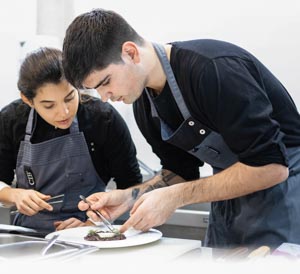
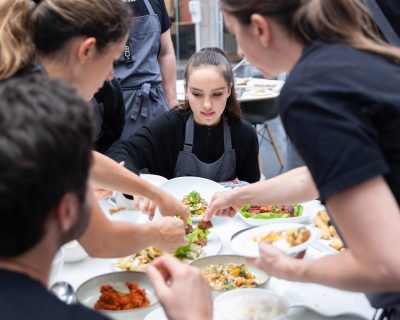
At the CIB, we have built a completely different approach, one that goes beyond the limits of traditional education, through our own methodology known as #CookingTomorrow. The CIB is not just a culinary school. It is a high-performance center for those who come to lead.
Our work is structured around four core pillars:
· Knowledge: Technique, science, and fundamentals. Knowing the rules inside out in order to reinterpret them with judgment.
· Skills: Operations, management, and leadership. Being a chef means more than knowing how to cook.
· Attitudes: Initiative, empathy, and vision. What no textbook can teach.
· Possibilities: The ability to anticipate and transform. Preparing for the future.
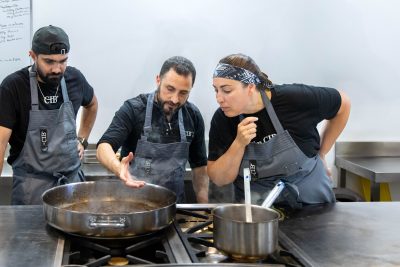
And we do all this in real-world environments, not through theoretical simulations.
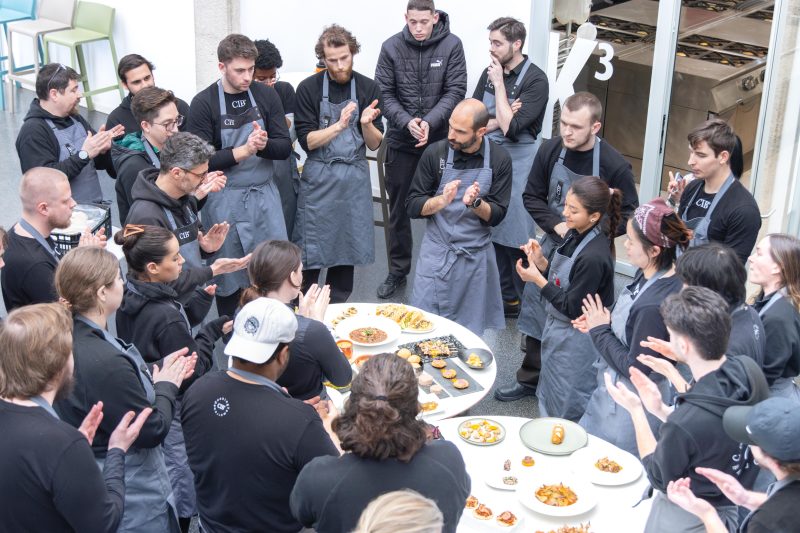
A comparison of the three possible paths. Which one fits you best?
| Feature | Path 1 – Professional Experience | Path 2 – Traditional Eeducation | Path 3 – CIB Methodology |
| Focus | Practical and operational. | Theoretical and technical. | Holistic. Real challenges and management. |
| Scope | Day-to-day execution. | Classical repertoire. | A complete vision: business, technique, and future. |
| Main challenge | Long-term learning curve. | Adapting to real-world pace. | High demand for innovation and sound judgment. |
| Profile | Resilient professional. | Academically trained technician. | Versatile and innovative leader. |
A) Dynamic learning: life is about challenges
“You have this budget, this timeframe, and this objective. Make it viable. Make it profitable. Make it real.” There are no exams here. We work with real scenarios, real pressure, and real decisions, creating the conditions for your creativity to emerge. And if you make mistakes, even better. Here, mistakes are part of the learning process, not a punishment or something to be ashamed of.
B) Global connection: your network from day one
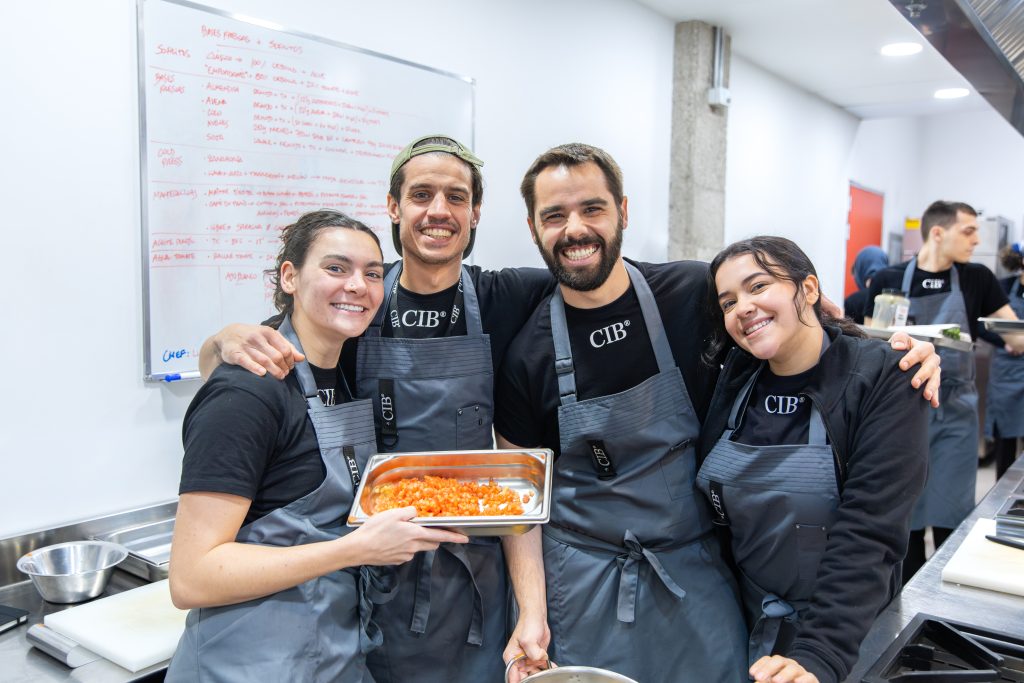
Learning alongside people from more than 90 countries is an opportunity few experiences can offer. Sharing the classroom with chefs and professionals who are leaders in their fields. Studying at CIB doesn’t feel like preparing for the world, it feels like designing your place within it.
C) Applied innovation: spaces designed to create the future
The CIB’s facilities span over 1,600 m² designed to spark ideas. We move away from traditional classrooms. Because in the 21st century, those who don’t innovate can only aspire to follow those who do.
#NoChef: toward a more human and sustainable industry
There is also another uncomfortable truth: for many years, the kitchen has often been a place of abuse, shouting, and exhaustion. Fortunately, gastronomy is evolving toward more sustainable models, not only in products and techniques, but also in the way people are managed.
At the CIB, we promote the #NoChef initiative, which advocates for dignifying the profession.
· We train you to manage teams with empathy and efficiency.
· We believe that a great professional must also be a good person.
· We give you the tools to build healthy, productive work environments.
Training here is not just about preparing yourself to lead, it is about committing to doing it the right way.
Investment and projection: the value of your time
It’s not just a question of cost. It’s a question of time.
· Professional path: Years to progress. Fragmented learning. Too many “maybes.”
· CIB path: Intensive months. Comprehensive learning. Real access to leadership roles.
It’s about gaining professional maturity, the tools, and the vision to design your own path. Graduating from the CIB is more than earning a degree.
Your decision: execution or strategy?
You can be part of the mechanism. Or you can design it.
The kitchen of the future needs leaders. People who know how to cook, yes, but also how to build teams, lead, innovate, anticipate trends, understand the business, and make difficult decisions. People capable of creating new models, not just perfecting old ones.
There are many paths. But only one prepares you to transform. Will you follow the path that’s already been laid out, or are you ready to build your own?